

For a five-person team, the best help desk software for small business usually comes down to the monthly bill. At list prices checked on 6 September 2026, five agents pay $60 on Gorgias Basic, $125 on Help Scout, $275 on Freshdesk Pro or Zendesk Suite Team, and $425 on Intercom Advanced, before any AI. A workspace-priced tool like Sellio's Mini plan is $20 for the same five seats. Below is every pick with its five-seat bill, the AI charges that land on top, and who each one actually suits.
All prices are each vendor's published list price per month, checked on 2026-09-06. Annual and monthly billing differ on some plans, and taxes are extra, so confirm on the vendor's own page before you sign.
The picks at a glance
Ordered by what five seats cost on the plan most small teams end up needing. The cheapest tool on paper is not always the cheapest once you add AI, so read the last column too.
| Tool | Best for | Plan used | 5 seats per month | AI on top |
|---|---|---|---|---|
| Sellio | Chat plus email and a few channels, flat budget | Mini | $20 (Essentials $95 for 10 seats) | Usage past included credits |
| Gorgias | Shopify stores priced by ticket volume | Basic | $60 | About $0.90 to $1.00 per AI resolution |
| Help Scout | Email-first teams that want calm, simple tooling | Standard | $125 | $0.75 per chatbot resolution |
| Hiver | Teams that want to stay inside Gmail | Growth | $125 yearly, $175 monthly | Varies by plan |
| LiveChat | Chat-heavy sales and support | Team | $245 yearly, $295 monthly | ChatBot sold separately, from $52 |
| Freshdesk | Classic ticketing with room to grow | Pro | $275 | Copilot $145 for 5, AI agent sessions extra |
| Zendesk | Teams that need phone and deep workflows | Suite Team | $275 | Copilot $250 for 5, per-resolution AI agents |
| Front | Email collaboration across sales and support | Professional | $325 | Copilot $100 for 5, Autopilot from $0.05 a conversation |
| Intercom | Product-led SaaS betting on an AI agent | Advanced | $425 | Fin from $0.99 per outcome, Copilot $145 for 5 |
What a 5-person support team needs from a help desk
Five agents is the size where a shared Gmail account stops working. Two people answer the same customer, nobody owns the angry refund thread, and nobody can tell you the average reply time. You need fewer things than most vendors sell, though.

- One queue for every channel you actually use, with clear ownership of each conversation.
- Internal notes and a warning when a teammate is already replying.
- Saved replies for the twenty questions you answer every week.
- Basic reporting: first response time, resolution time and customer satisfaction.
- Pricing you can predict when you hire person number six.
SLA policies, skills-based routing, sandbox environments and multi-brand help centers matter at fifty agents. At five they mostly raise the plan tier you are pushed into. If you want to sanity check your headcount first, the support agent capacity planner estimates how many people your volume really needs.
1. Sellio: one flat price per workspace
This is our product, so weigh this entry with that in mind. It is a shared inbox and live chat platform built for support teams of roughly two to twenty people. Pricing is per workspace, never per seat. Mini is $20 a month with 5 seats and 3 channels, Essentials is $95 with 10 seats and 5 channels, and Plus is $295 with 50 seats and 25 channels. There is also a free plan with 2 seats and website chat.
Live channels today include website chat, email, Telegram, Slack and Discord. WhatsApp, Instagram and Facebook Messenger are coming soon, not available yet. The AI agent answers on website chat from your own site and documents, hands off to a person when unsure, and can be capped so spend stays fixed. Tickets, automations and analytics (response time, resolution, CSAT) sit on the same conversations.
Pros:
- Five seats cost $20; ten cost $95. Hiring does not change the bill until you outgrow the plan.
- Chat widget installs with one script tag on any site.
- Native Mac desktop app (Windows is coming soon).
Cons:
- No phone or voice channel for customers, and no SMS yet.
- The AI agent works on website chat only. Email and Telegram messages go to a person.
- AI usage past the included credits costs extra.
- Not a fit if you need HIPAA or data residency.
Verdict: the cheapest way to give five people a proper shared inbox with live chat. Skip it if phone support is part of the job. Plan details are on the pricing page.
2. Gorgias: ticket-priced help desk for Shopify stores
Gorgias is built for ecommerce. It pulls order data into each ticket so agents can see what a customer bought without opening the store admin. The catch is that it charges by monthly ticket volume rather than by seat, so the bill follows your busy season.
Pricing, checked 2026-09-06: Starter $10, Basic $60, Pro $360, Advanced $900 a month. Extra tickets cost about $0.36 to $0.40 each. The AI Agent adds about $0.90 to $1.00 per resolved conversation. See Gorgias pricing.
Pros:
- Seats do not drive the price, so five agents cost the same as two.
- Order context in the ticket is the reason Shopify stores choose it.
Cons:
- A holiday spike can push you into overage or the $360 tier.
- Little reason to pick it if you do not sell on a store platform.
Verdict: strong for a store with steady volume. Model your December ticket count before you commit.
3. Help Scout: the email-first favourite
Help Scout feels like a well-organised email client for a team. Conversations look like normal email to customers, and the Docs knowledge base and Beacon chat widget come with it. Small teams like it because there is very little to configure.
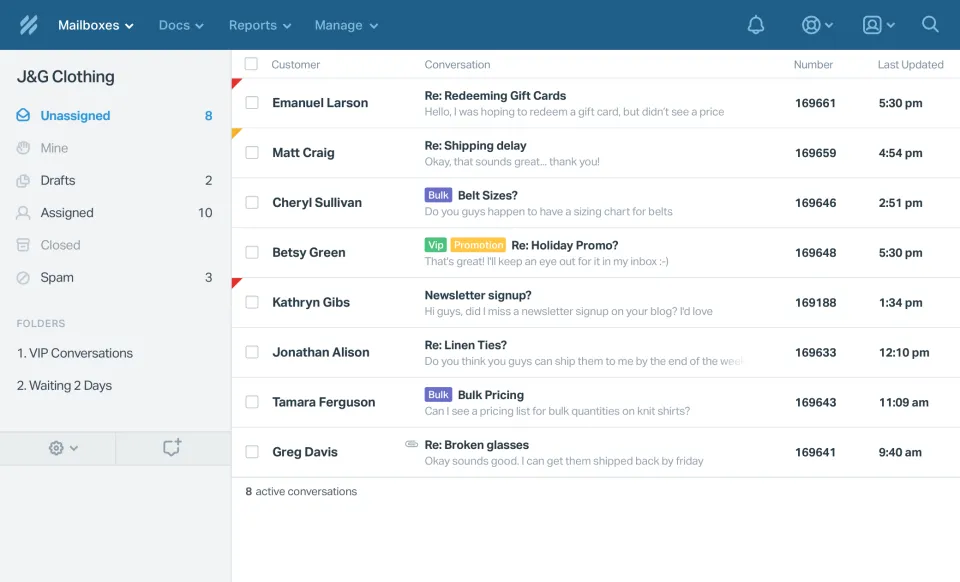
Pricing, checked 2026-09-06: Free $0, Standard $25, Plus $45 and Pro $75 per user per month. Five users on Standard: $125. The AI Inbox assistant is included; AI Answers, the chatbot, costs $0.75 per resolution. See Help Scout pricing.
Pros:
- Fast to learn; most teams are working in it the same day.
- AI drafting help is included in the seat price.
Cons:
- Per-user pricing: ten users on Standard is $250, on Plus $450.
- Per-resolution AI adds up if the chatbot handles a lot of volume.
Verdict: the safe pick for an email-heavy team. We compared it head to head in Freshdesk vs Help Scout for a 5-person team.
4. Hiver: a help desk inside Gmail
Hiver turns shared Gmail addresses like support@ into an assignable queue without moving anyone out of Gmail. For a team that already lives there, it is the least disruptive change you can make.
Pricing, checked 2026-09-06: Free $0, Growth $25, Pro $45, Elite $75 per user per month on yearly billing ($35, $55 and $95 monthly). Five users on Growth: $125 a month yearly, $175 monthly. Harvey AI features depend on the plan. See Hiver pricing.
Pros:
- No new app to learn if your team works in Gmail all day.
- Yearly billing cuts the per-user price by $10.
Cons:
- Which AI features you get depends on the plan, so check the tier before you buy.
- Monthly billing makes it pricier than Help Scout at the same headcount.
Verdict: the easiest switch for a team that runs on Gmail, though rarely the cheapest.
5. LiveChat: chat first, priced per agent
LiveChat is a mature website chat product that many small sales and support teams start with. Its strength is the chat itself; email ticketing gets less attention.
Pricing, checked 2026-09-06: Starter $19, Team $49, Business $79 per agent per month yearly ($25, $59 and $89 monthly). Five agents on Team: $245 yearly or $295 monthly. Text Intelligence (suggestions and summaries) is included; the separate ChatBot product starts at $52 a month yearly. See LiveChat pricing.
Pros:
- Polished chat experience for visitors and agents.
- AI assistance for agents included on the plan.
Cons:
- A chatbot that answers customers is a second product and a second bill.
- $245 or more for five seats is a lot for chat alone.
Verdict: worth it if chat drives revenue. For support alone, cheaper options cover the same ground.
6. Freshdesk: classic ticketing with plenty of tiers
Freshdesk is a traditional ticketing help desk with a long feature list. The entry plan is cheap, but several things small teams ask for, such as custom reports, sit on Pro.
Pricing, checked 2026-09-06: Growth $19, Pro $55, Enterprise $89 per agent per month. Five agents: $95 on Growth, $275 on Pro. Freddy AI Copilot is $29 per agent per month yearly, so $145 for five. The AI agent comes with 500 trial sessions once per account, then $49 per 100 sessions. See Freshdesk pricing.
Pros:
- Deep ticketing that scales well past twenty agents.
- Growth is a low entry price if its limits fit you.
Cons:
- Pro plus Copilot for five agents is $420 a month.
- The AI agent trial is one time; after it, every 100 sessions is $49.
Verdict: solid if you expect to grow into a larger support org. Our Freshdesk alternative page covers what changes when you switch.
7. Zendesk: the full suite, at suite prices
Zendesk does nearly everything, including phone support, which several tools on this list lack entirely. That breadth is what you pay for, and a five-person team rarely uses most of it.
Pricing, checked 2026-09-06: Support Team $19 per agent, Suite Team $55, Suite Professional $115, Suite Enterprise custom. Five agents on Suite Team: $275. AI agents are billed per automated resolution on top of seats, and the Copilot add-on is $50 per agent, so $250 more for five. See Zendesk pricing.
Pros:
- Voice, messaging, email and help center in one suite.
- Huge marketplace of apps and integrations.
Cons:
- Suite Team plus Copilot for five agents is $525 a month before AI resolutions.
- Setup and admin take real time a small team rarely has.
Verdict: pick it when phone support is required. Otherwise see the Zendesk alternative breakdown.
8. Front: shared email for teams that sell and support
Front is a collaborative inbox that treats email, chat and other channels like a team workspace. It shines when sales, account managers and support all touch the same customers.
Pricing, checked 2026-09-06: Starter $25, Professional $65, Enterprise $105 per seat per month. Five seats: $125 on Starter, $325 on Professional. Autopilot, the AI agent, starts at $0.05 per conversation. Copilot and Smart QA are $20 per seat each, included on Enterprise. See Front pricing.
Pros:
- Excellent for internal discussion on customer threads.
- Cheap per-conversation AI pricing at the starting rate.
Cons:
- Professional plus Copilot for five seats is $425 a month.
- Built around email; chat-first teams may find it heavy.
Verdict: best when support shares customers with other teams.
9. Intercom: AI-first, priced like it
Intercom's pitch is the Fin AI agent plus a modern messenger. It suits product-led SaaS companies that want an AI to answer a large share of questions and can afford per-outcome pricing.
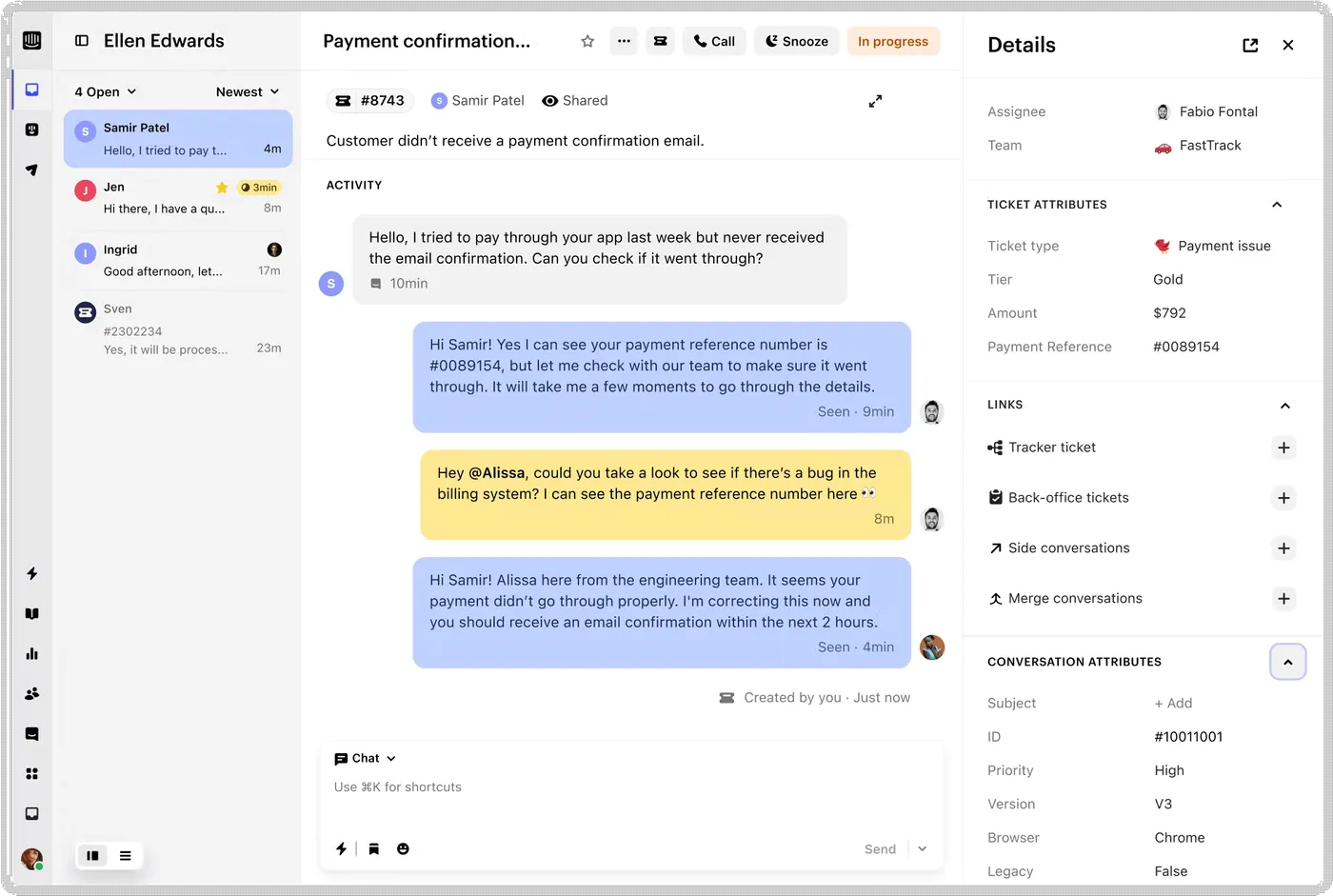
Pricing, checked 2026-09-06: Essential $29, Advanced $85, Expert $132 per seat per month. Five seats: $145 on Essential, $425 on Advanced. Fin costs from $0.99 per outcome on every plan. Copilot is $29 per agent yearly ($35 monthly). WhatsApp, SMS and phone are pay as you go. See Intercom pricing.
Pros:
- Strong AI agent and a polished customer messenger.
- Good fit for in-app support in a software product.
Cons:
- The most expensive pick here for five seats once Fin runs.
- Per-outcome AI makes the monthly bill hard to forecast.
Verdict: a strong product that only makes sense once you have priced Fin against your real monthly volume.
Hidden costs: AI, channels and add-ons
AI add-ons can double the seat bill. Here is a hypothetical five-person team whose AI fully resolves 400 conversations a month, priced with each vendor's published rates.
| Setup for 5 agents | Seats | AI add-ons | Monthly total |
|---|---|---|---|
| Help Scout Standard + AI Answers | $125 | 400 x $0.75 = $300 | $425 |
| Gorgias Basic + AI Agent | $60 | 400 x $0.90 to $1.00 = $360 to $400 | $420 to $460, plus any ticket overage |
| Freshdesk Pro + Copilot + AI agent | $275 | $145 + 400 sessions at $49 per 100 = $341 | $616 once the free trial sessions are used |
| Front Professional + Copilot | $325 | $100 + Autopilot from $20 | From $445 |
| Zendesk Suite Team + Copilot | $275 | $250 | $525, plus per-resolution AI |
| Intercom Advanced + Copilot + Fin | $425 | $145 + 400 x $0.99 = $541 | $966 |
Three other costs catch small teams out:
- Channel fees. Intercom bills WhatsApp, SMS and phone as you go, and Meta charges its own WhatsApp Business API fees whichever tool you use.
- Second products. LiveChat's customer-facing bot is a separate ChatBot subscription.
- Tier jumps. A single feature you need, such as a stronger automation, can move all five seats to the next plan.
The AI resolution cost calculator runs this math with your own numbers.
What to do when headcount doubles
Most small teams hire. Price ten seats now, because that is the bill you will be paying in a year or two.
- Help Scout Standard goes from $125 to $250.
- Freshdesk Pro and Zendesk Suite Team each go from $275 to $550.
- Front Professional goes from $325 to $650.
- Intercom Advanced goes from $425 to $850, before Fin.
- Our Mini plan at $20 tops out at 5 seats; Essentials at $95 covers 10.
- Gorgias does not change with seats, only with ticket volume.
The seat vs workspace pricing calculator shows where the lines cross for your team size.
How to choose the best help desk software for small business
- List your channels today and in twelve months. Phone support narrows the field fast: on this list only Zendesk and Intercom offer it.
- Pick the plan you will really need, not the entry plan. Check which tier holds the automations and reports you want.
- Estimate AI volume. Per-resolution pricing is cheap at 50 a month and expensive at 1,000.
- Price ten seats as well as five.
- Run a two-week trial with your real inbox and two agents, not a sales demo.
Quick recommendations: email-first and simple, Help Scout. Living in Gmail, Hiver. Shopify store, Gorgias. Phone required, Zendesk. AI-first SaaS with budget, Intercom. Live chat plus email on a fixed budget, a workspace-priced tool such as our help desk for small business. Side-by-side details for more tools are on the compare page.
FAQ
How much should a 5-person team spend on help desk software?
At September 2026 list prices, between $20 and $425 a month for seats alone, depending on the tool and plan. Add AI and most per-seat tools land between $400 and $1,000 for five agents.
Is a shared inbox enough, or do we need a full help desk?
For most teams under ten people, a shared inbox with assignment, notes, saved replies and basic reports covers the job. You need heavier ticketing when you run formal SLAs, many teams or several brands.
Which help desk has a free plan for small teams?
Help Scout and Hiver list free plans, and our free plan includes 2 seats with website chat. Free plans limit seats or features, so check them against your channel list.
Is per-seat or flat pricing better for a small team?
Per-seat pricing is fine while the team stays small and stable. Flat or workspace pricing wins when you expect to hire, or when part-time staff need a login without adding a full seat.
Do AI chatbots in help desks cost extra?
Usually, yes. Intercom, Help Scout, Gorgias and Front charge per resolution or per conversation, Freshdesk sells sessions in blocks, and Zendesk bills per automated resolution. Ask for the rate and set a monthly cap.