

For a support team of two to ten people, Intercom vs Zendesk mostly comes down to two things: where your customers talk to you, and how you'd rather pay for AI. Zendesk is cheaper per seat. Five agents on Zendesk Suite Team cost $275 a month, against $425 on Intercom Advanced, both checked on 2026-09-06. Intercom has the better chat product and publishes the price of its AI agent, Fin, at $0.99 per outcome. Zendesk also bills AI per automated resolution, but its rate wasn't among the prices we could check, so you'll need it from sales before you can compare totals.
If most of your support arrives by email, or your customers phone you, start with Zendesk. If they mostly type into a chat bubble on your site or inside your app, Intercom will suit you better, as long as someone watches the Fin line on the invoice. And if paying for five full seats feels like a lot for the volume you handle, the seat model may be what needs questioning.
We make Sellio, a shared inbox priced per workspace, so read the last part of this post with that in mind. Every Intercom and Zendesk price here comes from the vendor's own pricing page.
What five seats cost on each
Seats only, before any AI, from Intercom's pricing page and Zendesk's pricing page, checked on 2026-09-06:
| Price level | Intercom plan | Five seats a month | Zendesk plan | Five seats a month |
|---|---|---|---|---|
| Entry | Essential, $29 a seat | $145 | Support Team, $19 an agent | $95 |
| Middle | Advanced, $85 a seat | $425 | Suite Team, $55 an agent | $275 |
| Upper | Expert, $132 a seat | $660 | Suite Professional, $115 an agent | $575 |

The middle row is where most small teams land, and the gap there is $150 a month, or $1,800 over a year. Hiring a sixth agent adds $85 a month on Advanced and $55 on Suite Team.
Reading across a row can mislead you, though. The plans are lined up by where they sit on each price list, and they don't contain the same things. Zendesk Support Team is the email ticketing product; chat and messaging come with the Suite plans. So for anyone who wants a chat widget on their site, we'd treat $55, and $275 for five, as the real Zendesk starting point. Intercom's Essential includes the messenger, but look up which plan the features you rely on actually sit on before you budget off the cheapest line.
Suite Enterprise has no public price. If you can see yourself needing it within a year, ask for the number now, while switching vendors is still cheap.
Intercom vs Zendesk on AI: per outcome or per resolution
Seats are a fixed cost you can plan around. The AI agent is the line that moves with your ticket volume, and it's where the two vendors are least alike.

Fin, Intercom's AI agent, is priced from $0.99 per outcome and is available on every plan, Essential included. Zendesk's AI agents are billed per automated resolution, added on top of the seat price. Either way, the better the AI does its job, the bigger the invoice. A quiet month costs little. The week your payment provider goes down and two hundred people ask why they were charged twice, every one of those answers is billable.
Because Fin's rate is public, you can work out where the two stacks meet. Take a five-person team that expects the AI to close 400 conversations a month:
| Intercom Advanced | Zendesk Suite Team | |
|---|---|---|
| Five seats | $425 | $275 |
| 400 AI conversations | $396 at $0.99 each | 400 times Zendesk's rate |
| Monthly total | $821 | $275 plus the AI line |
They come out level if Zendesk charges about $1.37 per automated resolution. Below that, Zendesk stays the cheaper stack at this volume; above it, Fin's lower AI price wipes out Intercom's higher seat bill. The meeting point falls as volume rises. At 1,000 AI conversations a month it's about $1.14. Fin's $0.99 is a "from" price, so treat it as the floor, and use the AI resolution cost calculator if you want to try other volumes.
You don't need a vendor to estimate your own volume. Pull 100 recent conversations and mark the ones your help articles already answer. That share is the most an AI agent can realistically take, and you should plan on less, since some customers will ask for a person whatever the bot says.
Copilot is billed separately
Both vendors also sell an assistant for your human agents, the thing that drafts replies and summarises long threads. Intercom's Copilot is $29 per agent a month billed yearly or $35 monthly. Zendesk's Copilot add-on is $50 per agent a month. Turn it on for all five people and you add $145 to $175 on Intercom or $250 on Zendesk, which narrows the $150 seat gap to somewhere between $45 and $75.
We wouldn't buy it for everyone on day one. Give two seats to the people who write the most replies, run it for a month, then switch it off and see if they complain.
Questions to get answered in writing
- What counts as a billable outcome or automated resolution? If the AI answers and the customer then asks for a person, is that still charged?
- Can you set a monthly spending cap, and what does the AI do once you hit it?
- Does the AI agent need a particular seat plan, or does it work on the one you priced?
- Is the per-resolution rate fixed for the length of the contract?
Chat-first or ticket-first
Intercom started as a messenger, and it still treats a customer conversation as a live thread. Zendesk started as an email help desk, and anything that arrives becomes a ticket with a status, an assignee and a history. Each has spent years building the other's half, so you'll find tickets in Intercom and chat in Zendesk. What differs is which half feels like the product and which feels added later.
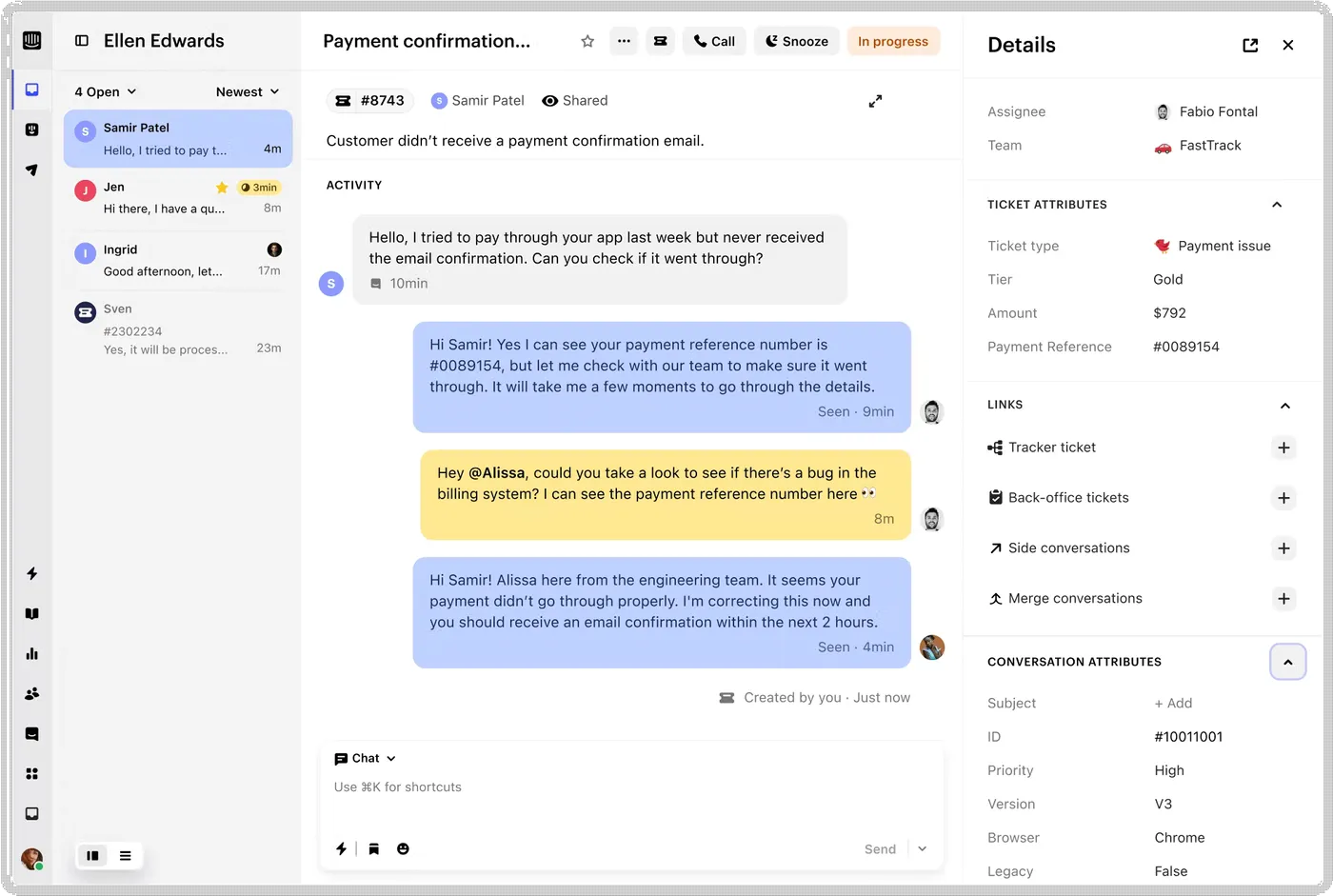
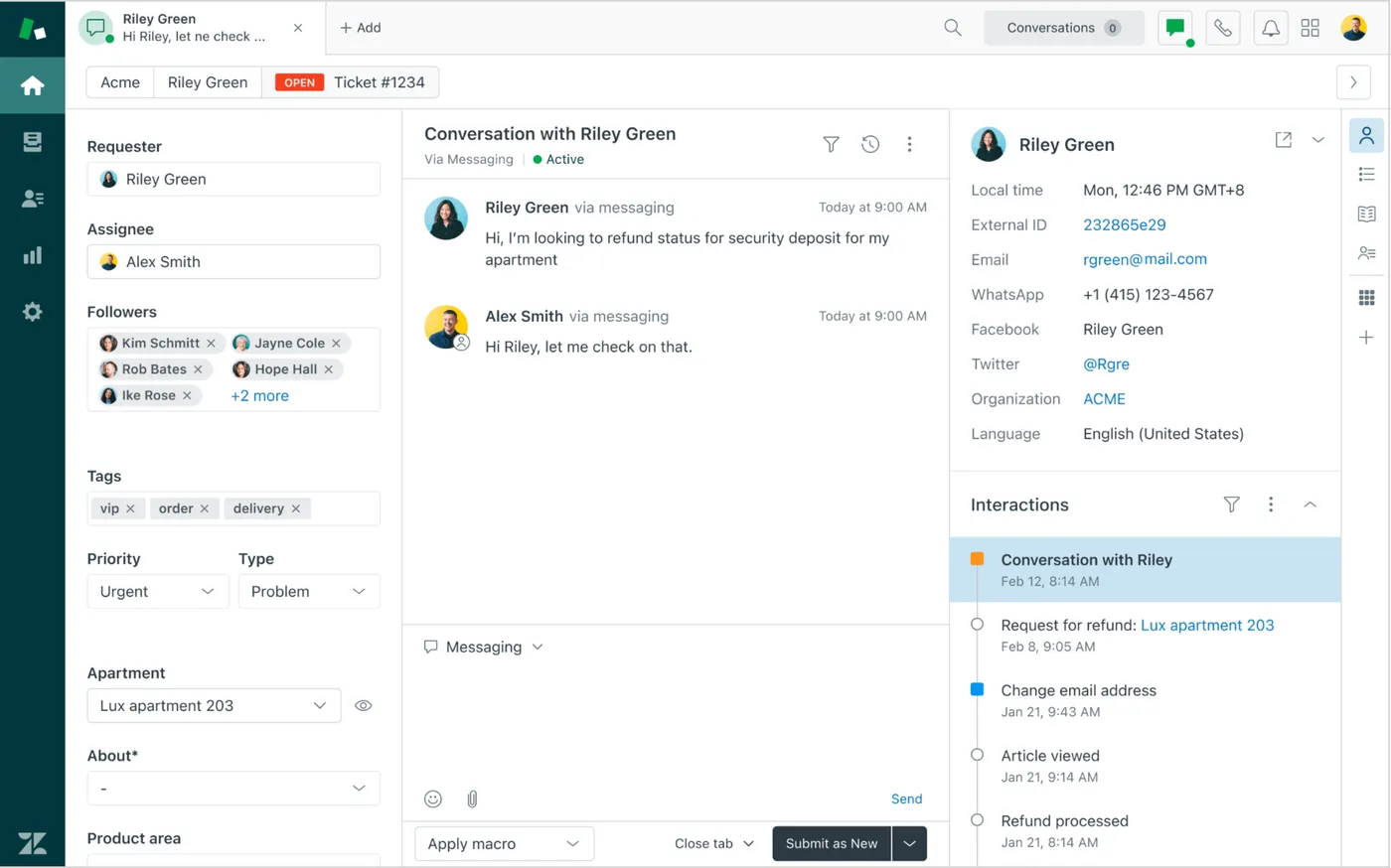
Picture your busiest Monday. If it's dozens of people in the chat widget asking how to export a report, Intercom was designed around that morning. If it's a queue of returns and invoice emails, two of them escalated from last week, plus a few voicemails, Zendesk was.
Phone separates them more than anything else. Zendesk offers voice. On Intercom, phone is pay-as-you-go, like WhatsApp and SMS, so you can have it but you'll pay per use on top of the seats. If a real share of your customers call, price that line before you look at anything else in this post.
When you trial them, skip the demo data. Forward a handful of real, messy conversations into each: a customer who writes twice about the same order, a thread that needs a colleague to step in. Then watch for small things. Can two agents tell that someone is already replying? Is an internal note obviously internal? How many clicks does it take to hand a conversation to someone else? The shared inbox basics are the same in any tool, and it's worth knowing what a simple version looks like before judging the big ones.
Setup, and who ends up maintaining it
In our judgement Intercom gets you to a working chat widget faster. Zendesk takes longer to configure and gives you more to shape once it's running: triggers, views, ticket fields, forms. Test that yourself, because your own habits will change the answer more than either vendor will.
For a team of five, the bigger question is who keeps it running. Small teams rarely have an admin. They have a support lead, or a founder, who tunes the help desk in between everything else. Zendesk's depth suits someone who enjoys building automations and turns into a weekly chore for someone who doesn't. If you already know which of those people you have, that may settle it.
One cheap test: hand each trial to a colleague who sat out the demo and ask them to answer a real customer with no instructions. Wherever they get stuck is roughly where your admin hours will go.
Intercom is now Fin, and Salesforce is buying it
Intercom now goes by Fin, the name of its AI agent, and on June 15, 2026 Salesforce signed a definitive agreement to buy Fin for about $3.6 billion. At the time, Salesforce expected the deal to close in the fourth quarter of its fiscal 2027, subject to regulators. We still call it Intercom here because that's the name people search for.
The prices in this post were checked in September, after the announcement. Nobody outside the two companies knows what a Salesforce-owned Fin will charge in two years. That's a reason to ask, before you sign, whether your seat price and the Fin rate are fixed for the full term and what renewal looks like. It isn't a reason to rule Intercom out.
Which one we'd pick for three kinds of team
A three-person SaaS company whose customers ask how-to questions inside the app wants answers in seconds, and the founders don't want to write macros at midnight. Intercom fits. We'd start on Essential, switch Fin on for a narrow set of questions, and only move to Advanced when a missing feature costs real time.
A five-person online shop gets most of its messages by email about orders and returns, and a few customers ring. Zendesk Suite Team suits it better: tickets for the email, voice for the calls, and a seat bill of $275 instead of $425. Price the AI agent after a month of real data, once you know how many questions repeat.
An eight-person agency where five people answer customers for a few hours a week is the awkward case. Both tools bill a seat used two hours a week exactly like one used forty, so this team pays for $425 or $275 of seats to cover what is really one person's workload.
When the per-seat model is the real problem
That agency points at something neither vendor will fix for you. Part-timers, weekend cover and the founder who answers the odd chat each cost a full seat, every month.
Sellio, which we build, charges per workspace instead. Mini is $20 a month for up to five seats and three channels, and Essentials is $95 a month for ten seats and five channels. AI use beyond the included credits costs extra, so you still budget for an AI line. The AI agent answers from your own website and documents, hands over to a person when it isn't sure, and can be capped so the spend can't run away. Plan details are on the pricing page, and the seat vs workspace pricing calculator runs the comparison for your own headcount.
It's a narrower product than either of the big two, and these gaps decide it for some teams:
- There's no phone or voice channel. If your customers call, Zendesk is the better choice.
- The AI agent answers on website chat only. Email and Telegram messages land in the shared inbox for a person to answer.
- WhatsApp, Instagram, Facebook Messenger and SMS are coming soon and can't be connected yet.
- HIPAA compliance and data residency aren't offered.
If you're already on one of the two and thinking of leaving, the Intercom alternative and Zendesk alternative pages go into more detail. For the same question asked about two other help desks, see Freshdesk vs Help Scout for a 5-person support team.
FAQ
Is Zendesk cheaper than Intercom for a small team?
On seats, yes. Five agents cost $275 a month on Zendesk Suite Team and $425 on Intercom Advanced, checked on 2026-09-06. Once AI is included it depends on Zendesk's per-resolution rate: at 400 AI conversations a month, Zendesk stays cheaper only while that rate is under about $1.37.
Which is better for live chat on a website?
Intercom. It began as a messenger and its chat widget is still the center of the product. Zendesk offers chat and messaging on its Suite plans, connected to the ticket system behind it, which suits teams that think in tickets.
How does AI pricing differ between Intercom and Zendesk?
Intercom bills its Fin AI agent from $0.99 per outcome on every plan. Zendesk bills its AI agents per automated resolution, on top of the seat price. The assistant for human agents, Copilot, is $29 to $35 per agent a month on Intercom and $50 on Zendesk. Ask both what exactly counts as a billable outcome.
Can a five-person team run Zendesk without a dedicated admin?
Yes, but someone will own it on the side. Zendesk repays the hours spent on triggers, views and fields. If nobody on your team wants to spend those hours, we'd lean toward a simpler tool.
Does the Salesforce deal change Intercom's pricing?
Not in the prices we checked in September 2026, after the deal was announced. Future pricing is unknown, so ask for your seat price and the Fin rate to be fixed for the contract term.